Tuesday, November 2, 2010

Amazing 3D Sidewalk Art

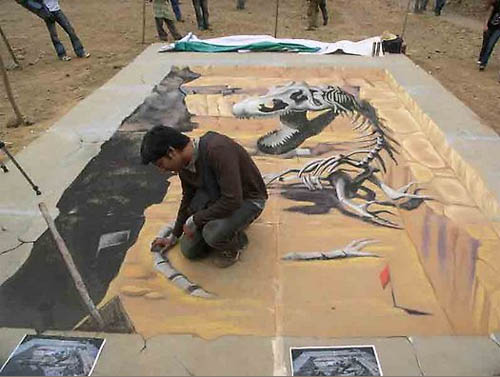
They are amazing because they 1) look real 2) are completely flat but look 3 Dimensional 3) drawn only with chalk.

The author of these great drawing is a super creative person also known as Pavement Picasso whose name is Julian Beever.

Not to reinvent the wheel I will cite Wikipedia: “Julian Beever is an English chalk artist who has been creating trompe-l’œil chalk drawings on pavement surfaces since the mid-1990s. His works are created using a projection called anamorphosis, and create the illusion of three dimensions when viewed from the correct angle.

Beever works as a freelance performance artist and creates murals for companies.” Keep in mind that every sidewalk drawing is entirely flat!

Phew, that was an easy introduction! Enjoy the pictures, my friends.

The Artist Faces Himself
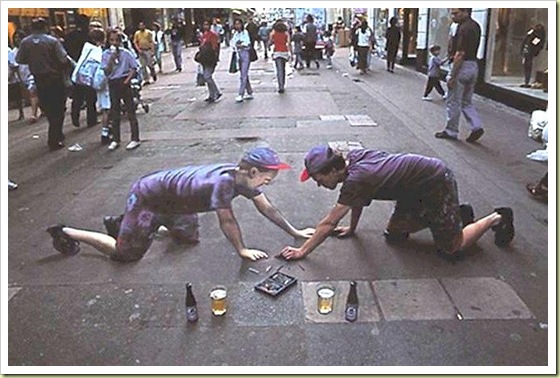


How did he know how he looks from the side? I bet he asked someone to take his picture in that position. And one little interesting detail – the beer on the left is real, not on the right.


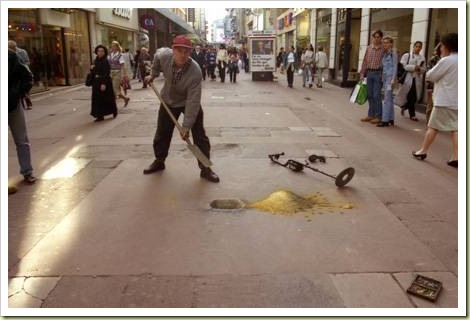
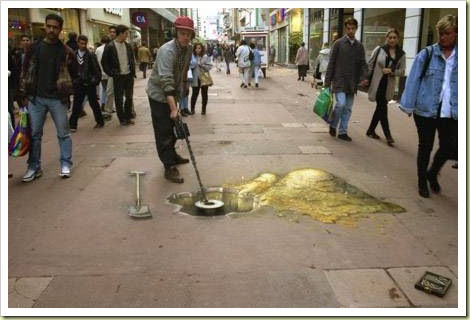
 Square Of Slabs Removed From Sidewalk
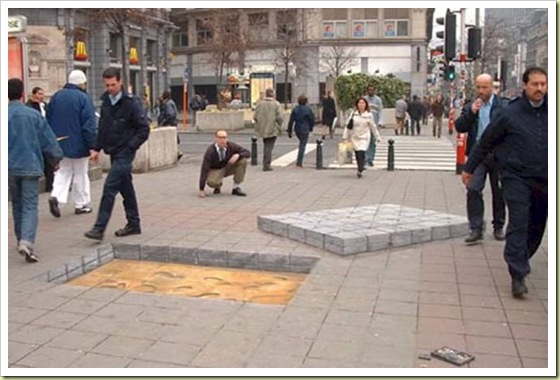


Someone has to punish him for ruining the public property!


Eiffel Tower Sand-Sculpture
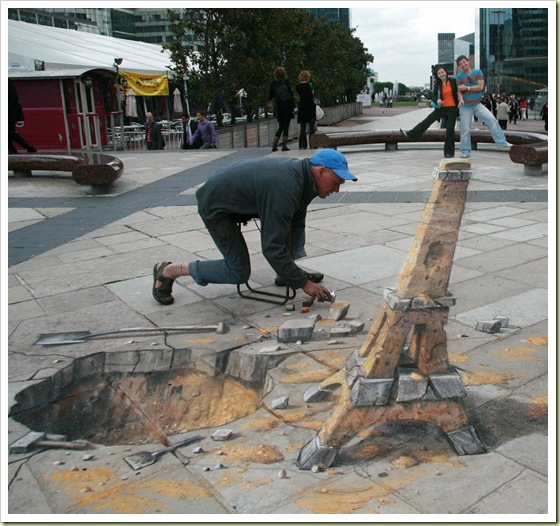


Look closely at the tip of the Tower – there are a couple standing on it. I hate the bench behind them, because it’s ruining the picture.
This drawing was drawn in Paris and used in Gallery HD television series “Concrete Canvas” (Episode 8).


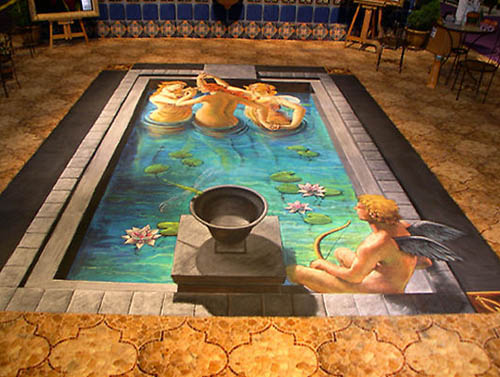
Waterpool with a chick, Redondo Beach, CA
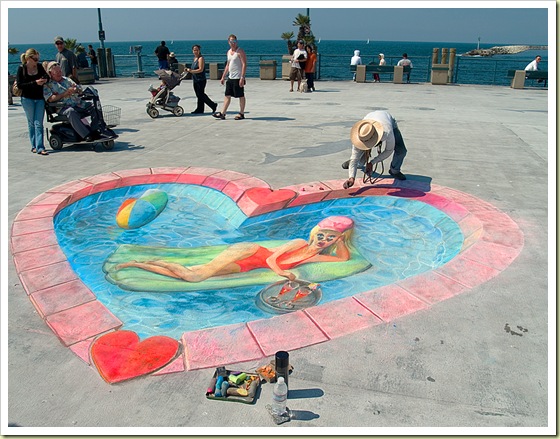


This drawing was also created for an episode of “Concrete Canvas”.


A Coca-Cola Bottle Lying On The Sidewalk
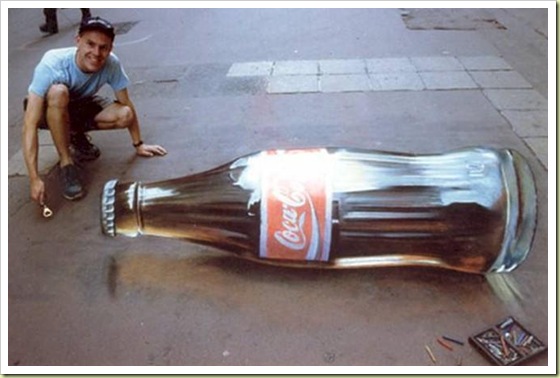


It seems that Julian Beever is a huge fan of brands.


Box Of Chalks
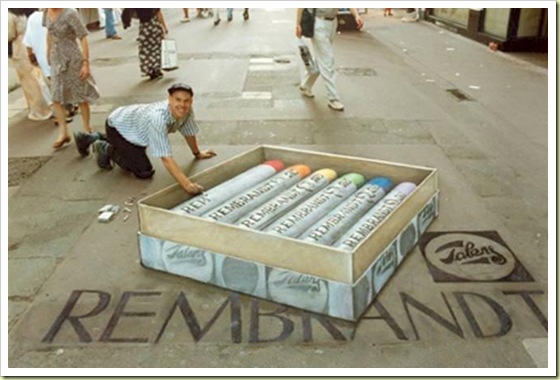


Those must be the chalks he uses for his pavement drawings.


A Dead Fly On The Sidewalk
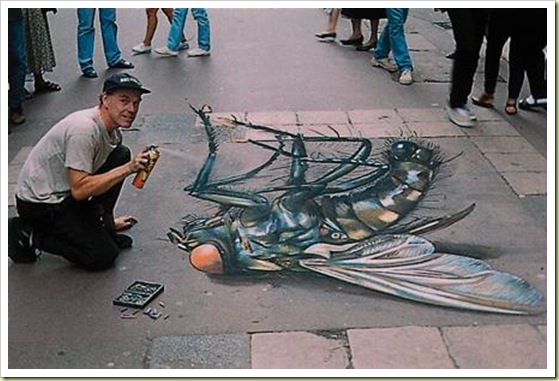


Julian Beever knows how to make his drawing even cooler.


Transformer at Union Square
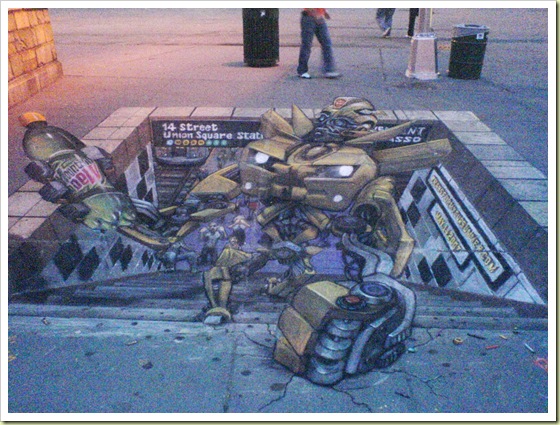


Transformer comes out from the pavement. Seems a bit astonished.


Holes on San Francisco pavement
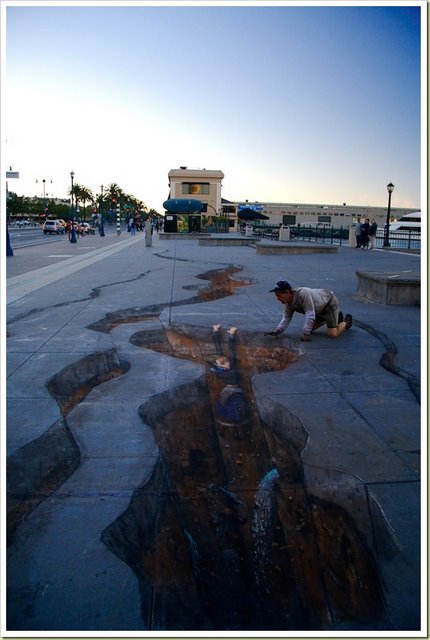


Be careful not to fall down here!


Nokia Town?
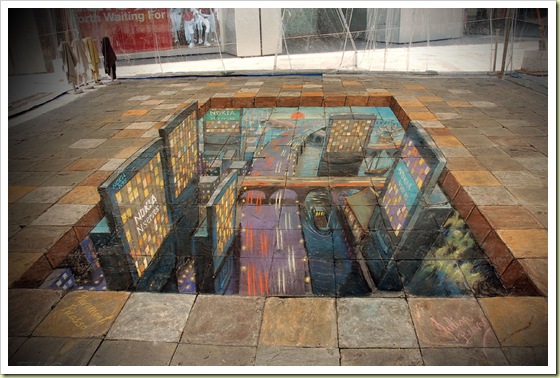


This drawing is in Singapore. Not sure if the title is correct. Again, it shows that he is a fan of brands. Or maybe Nokia paid him?


Dies Irae (Day of Wrath)
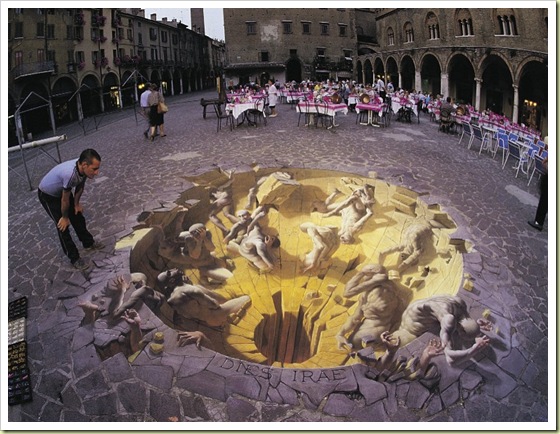


The day of wrath has begun with this hole on the pavement.


Batman & Robin to the Rescue
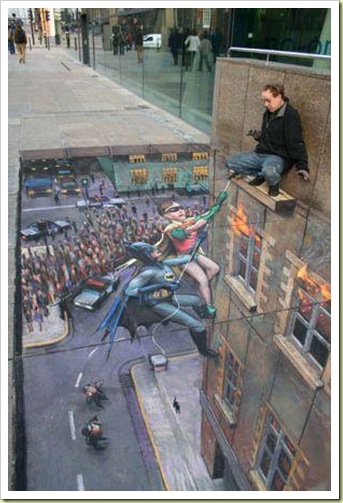


It is still hard to believe that it is entirely flat surface.


Water Rafting
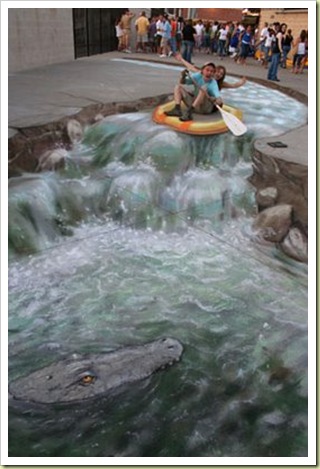


The illusion is quite strong here, of course they are just sitting in one place and look quite stupid for the people passing by.


Ants
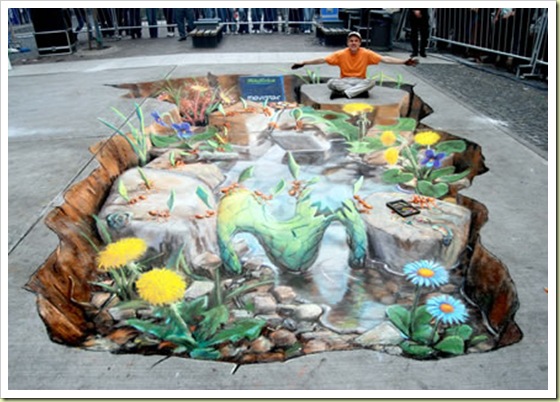


At first, it is hard to understand what the drawing is all about. But I can cite the author from his website: “Ants : a colony of leaf-cutter ants builds a bridge in Buenos Aires.” Would you have guessed it?


Arctic street conditions
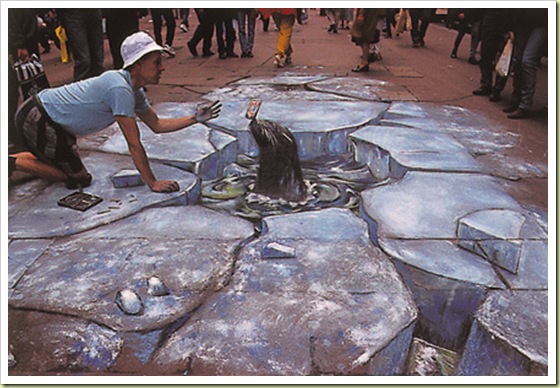


After a hard work a seal came out of the pavement and rewarded Julian Beever with a soft drink.


DHL Boy


A DHL boy delivering a parcel all the way from China – that’s how they do it so fast!


Push the bout out
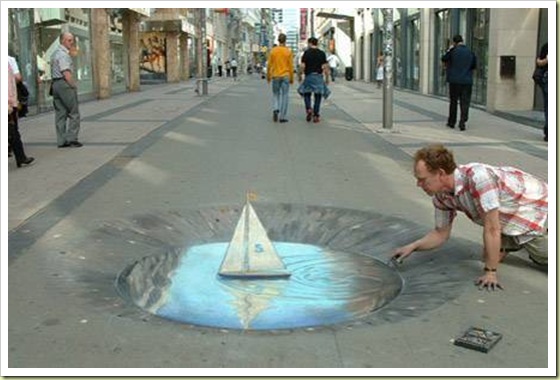


I think it is the most realistic illusion, seems like a real hole with a water inside.


Politicians Meeting Their End
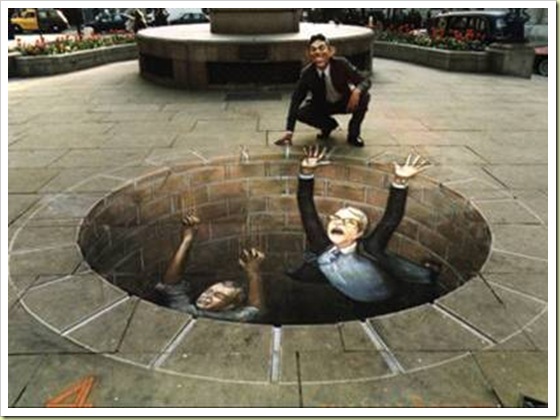


At last – politicians are meeting their end! But don’t be so happy, its just an illusionary drawing…
It was drawn near The Bank of England and was commissioned by Channel 4′s Midnight Special for the night of the 1997 General Election.


Bottle of Beer
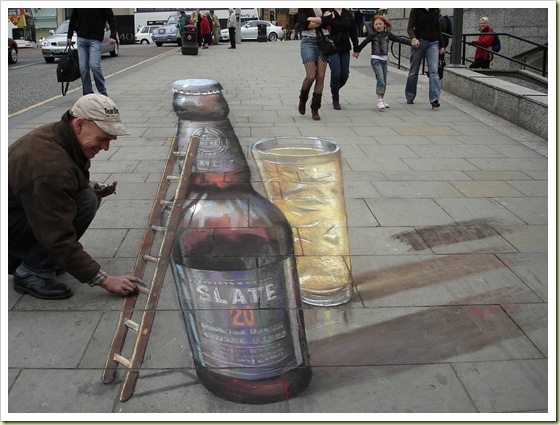


This picture would look best if someone was standing on it’s cork. (I think there is such picture in authors website).


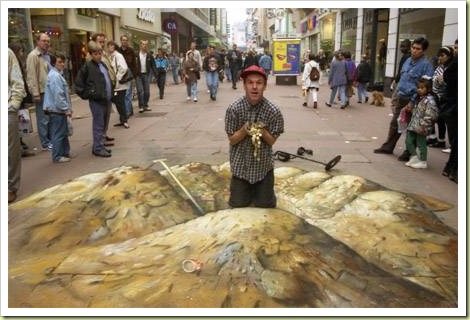
Gold digging
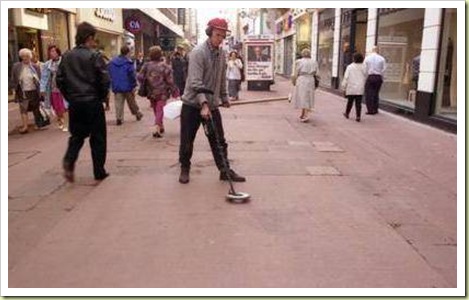


(Image credits: Richard Johnson Hurtado)


This guy is incredible! (and must be rich too, since he found gold beneath the pavement).
The series were used by White’s Electronics of Inverness in Treasure Hunting magazine.


Taking the plunge
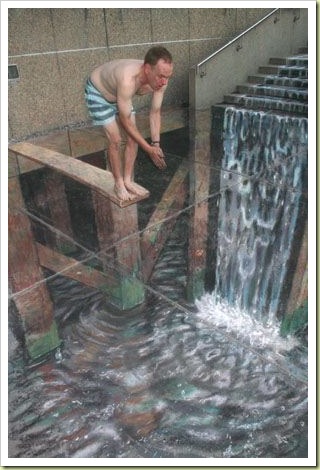


If Julian really took that plunge, that must have hurt his head really bad.


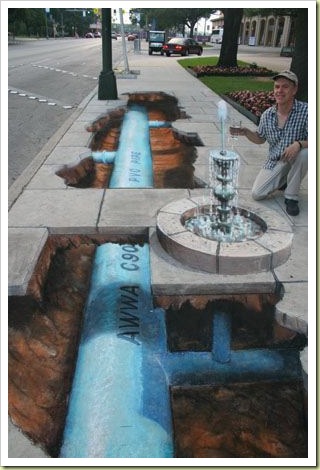
Beneath every street
Sunday, October 31, 2010

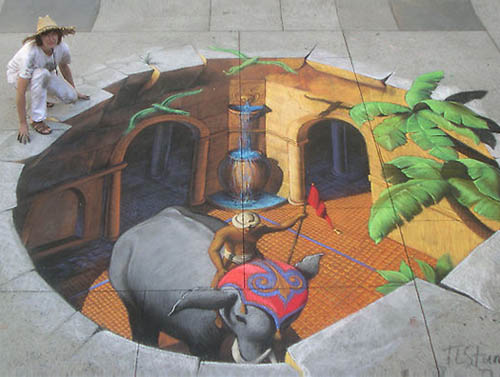
3D Street Paintings by Tracy Lee Stum

“A professional street painter or madonnara, Tracy Lee Stum is a fine artist committed to creating spectacular modern masterpieces that transform, captivate and inspire.”

She is best known for her 3D street paintings, also called anamorphic or pavement chalk art.

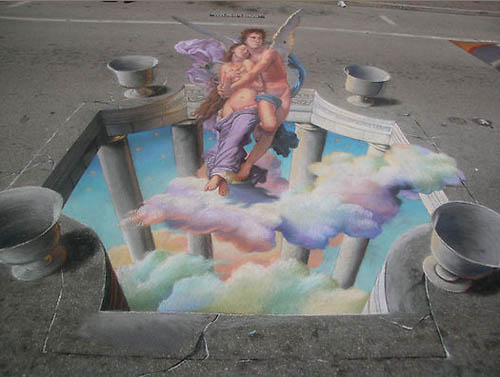
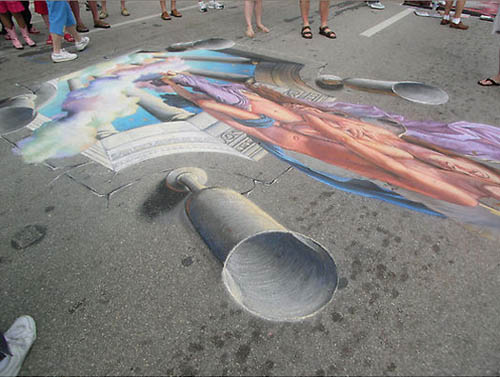
“3D Anamorphic Street Paintings are illusionary 2-dimensional images that appear to become 3-dimensional when viewed from a fixed point through a camera lens.”


“Tracy has been creating these types of chalk art images since she first started street painting and continues to challenge herself through this manner of visual expression.”

– excerpts from her website.

She has traveled the world to be a featured artist in many festivals and events, and she currently holds the Guinness World Record for the largest street painting by an individual, which she completed in 2006.
Tracy Lee Strum was kind enough to give us an exclusive permission to use her photos on villageofjoy.com and share them with you. Now let the art talk for itself!


#1


#2


#3


#4


#5


#6


#7


#8


#9


#10


#11


#12


#13


#14


#15 (the same as #14 but from different angle)


#16


#17


#18


#19


#20

Friday, October 29, 2010

Top 10 Strange Holes in the World

These top 10 strange holes are geographical phenomena and most astounding sites in the world. Some hole are made occasionally by nature but some  by the man in search for the mining wealth. Here we point out the top ten biggest and strangest of them.


1. Darvaza Gas Crater – Turkmenistan (The Door to Hell):


Darvaza Gas Crater - Turkmenistan (The Door to Hell)

Darvaza Gas Crater - Turkmenistan (The Door to Hell)

In the heart of the Karakum desert of Turkmenistan the Darvaza Gas Crater or The Burning Gates give off a glow that can be seen from miles away during the dark night. The large crater is a result of a Soviet gas exploration accident in the 1950’s. It was created when a Soviet drilling rig was drilling for natural gas fell into an underground cavern resulting in a crater which today measures roughly 60 meters in diameter and 20 meters deep. The huge crater was set alight shortly after being discovered and has been burning ever sinse. The smell of burning sulfur can be detected from a distance and becomes quite strong as you near the hot edge of the crater.


2. Kimberley Diamond Mine – South Africa:


Kimberley Diamond Mine - South Africa

Kimberley Diamond Mine - South Africa

The Kimberley Diamond Mine (also known as the Big Hole) holds the (disputed) title of being the largest hand-dug hole in the world. From 1866 to 1914 50,000 miners dug the hole with picks and shovels, yielding 2,722 kg of diamonds. Attempts are being made to have it registered as a world heritage site. The Big Hole has a surface of 17 hectares (42 acres) and is 463 metres wide. It was excavated to a depth of 240 m, but then partially infilled with debris reducing its depth to about 215 m; since then it has accumulated water to a depth of 40 m leaving 175 m visible. Beneath the surface, the Kimberly Mine underneath the Big Hole was mined to a depth of 1097 metres. A popular local myth claims that it is the largest hand-dug hole on the world, however Jagersfontein Mine appears to hold that record.


3. Monticello Dam – California:


Monticello Dam - California


Monticello Dam - California

Monticello Dam is a dam in Napa County, California, constructed between 1953 and 1957. The dam is a medium concrete-arch dam with a structural height of 304 ft (93 m) and a crest length of 1,023 ft (312 m). It contains 326,000 cubic yards (249,000 m³) of concrete. The dam impounds Putah Creek to form Lake Berryessa, the second-largest lake in California. The capacity of the reservoir is 1,602,000 acre·ft (1,976,000 dam³). Water from the reservoir is supplied mostly to the North Bay area of San Francisco. The dam is noted for its classic, uncontrolled spillway with a rate of 48,400 cubic feet per second (1370 m³/s) and a diameter at the lip of 87 ft (27 m).


4. Bingham Canyon Mine – Utah


Bingham Canyon Mine - Utah

Bingham Canyon Mine - Utah

The Bingham Canyon Mine is a copper mine in the Oquirrh mountains, Utah. The mine is 0.75 mile (1.2 km) deep, 2.5 miles (4 km) wide. It is the world’s largest manmade excavation. The mine has been in production since 1906, and has resulted in the creation of a pit covering 1,900 acres (7.7 km²). Over its life, Bingham Canyon has proven to be one of the world’s most productive mines. As of 2004, ore from the mine has yielded more than 17 million tons (15.4 Mt) of copper, 23 million ounces (715 t) of gold, 190 million ounces (5,900 t) of silver, and 850 million pounds (386 kt) of molybdenum.


5. Great Blue Hole – Belize


Great Blue Hole - Belize

The Great Blue Hole is an underwater sinkhole off the coast of Belize. The hole is 1,000 feet across and 400 feet deep. It was formed as a limestone cave during the last iceage. This is a popular spot amongst recreational scuba divers, who are lured by the opportunity to dive in crystal clear water and meet several species of fish, including giant groupers, nurse sharks and several types of reef sharks such as the Caribbean reef shark and the Blacktip shark.


6. Mirny Diamond Mine – Siberia:


Mirny Diamond Mine - Siberia

The Mirny Diamond Mine is 525m deep and has a diameter of 1200m. It was the first, and one of the largest, diamond Pipes in the USSR. It is now abandoned. While it was still operational, it would take two hours for trucks to drive from the top to the bottom of the mine. Currently, the mine is operated by Alrosa, the largest diamond producing company in Russia, and employs 3600 workers. It has long been anticipated that the recovery of diamonds by conventional surface methods will saturate. Therefore, in 1970s construction has started of a network of underground tunnels for diamond recovery. Production of diamonds by this method started in 1999 and is estimated to last for another 27 years. This estimate is based on depth explorations down to 1220 meters. In order to stabilize the abandoned main pit, its bottom was covered by a rubble layer 45 meters thick.


7. Diavik Mine – Canada


Diavik Mine - Canada


Diavik Mine - Canada

The Diavik Mine is a mine in the Northwest territories of Canada. The mine (opened in 2003) produces 8 million carats or about 1,600 kg (3,500 lb) of diamonds every year. The mine is owned by a joint venture between the Harry Winston Diamond Corporation and Diavik Diamond Mines Inc., a subsidiary of Rio Tinto Group. The lifespan of the mine is expected to be 16 to 22 years. The mine consists of three kimberlite pipes associated with the Lac de Gras kimberlite field and is located on an island 20 square kilometres (8 sq mi) in Lac de Gras and is informally called East Island. It is about 220 kilometres (137 mi) south of the Arctic Circle.


8. Sinkhole – Guatemala:


Sinkhole - Guatemala


Sinkhole - Guatemala

In February 2007 a large sinkhole opened in a poor neighborhood in northeast Guatemala city, killing three people. The sinkhole was 100.5 m (330 ft) deep, and apparently was created by fluid from a sewer dissolving the rock underneath. As a result, one thousand people have been evacuated from the area. The sink hole has since been mitigated and plans to develop on the site have been proposed.


9. Udachnaya Pipe – Russia:


Udachnaya Pipe - Russia

Udachnaya Pipe - Russia

Udachnaya Pipe - Russia

The Udachnaya Pipe is a diamond mine in Russia. The owners of the mine plan to cease its operations in 2010 – in favor of underground mining. The mine was discovered in 1955 and is over 600 meters deep. The nearby settlement of Udachny is named for the deposit. As of 2004, Udachnaya pipe is controlled by Russian diamond company Alrosa, which plans to halt open-pit mining in favor of underground mining in 2010


10. Chuquicamata – Chile


Chuquicamata-Chile


Chuquicamata-Chile

Chuquicamata or “Chuqui” as it is more familiarly known, is an open pit copper mine in Chile. It is the mine with the largest total production of copper in the world – though it is not the largest copper mine. The mine is over 850 meters deep. Copper has been mined for centuries at Chuquicamata as was shown by the discovery in 1898 of “Copper Man”, a mummy dated at about 550 A.D. which was found trapped in an ancient mine shaft by a fall of rock. It is also said that Pedro de Valdivia obtained copper horseshoes from the natives when he passed through in the early 16th Century.

Related Post